

Vineyards, Cathedrals and Wine Windows

There are trips that fill your camera roll, and then there are journeys that quietly settle into your soul. My two weeks in Italy became the latter; a collection of moments stitched together not by itineraries or landmarks alone, but by scent, flavor, conversation, and the deep, lingering beauty of slowing down long enough to truly see a place.
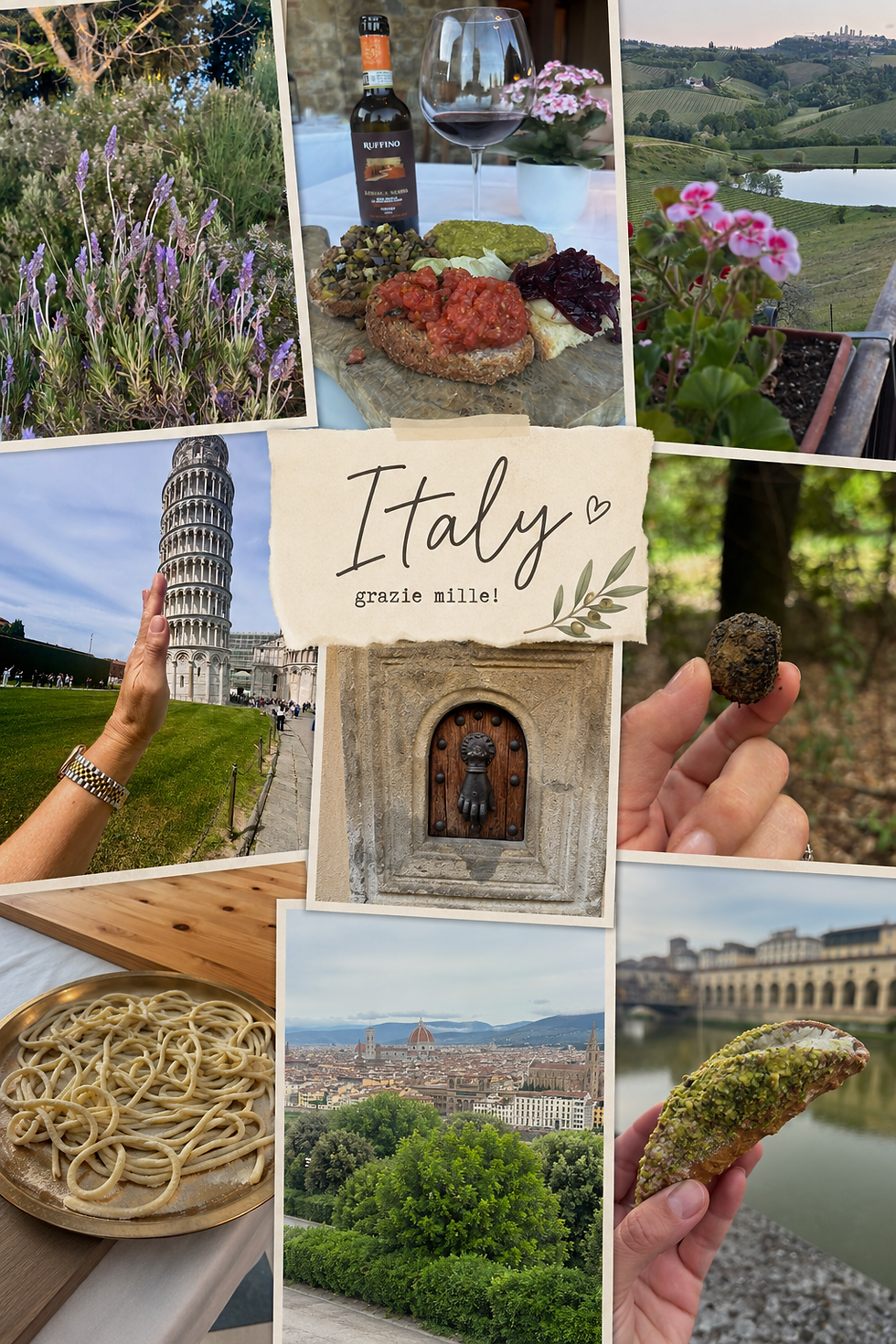
I began in Tuscany, a region I have visited several times before, yet somehow had never fully explored the Chianti countryside. The landscape unfolded like a painting I could never quite stop staring at; endless olive groves and vineyards rolling across the hills, rosemary and lavender drifting through the warm air, plump figs hanging heavily from trees. Church bells echoed in the distance while cows mooed somewhere beyond the vineyards, creating the kind of soundtrack that makes you feel immediately connected to the land itself.
After a full day resting from travel, we ventured into nearby villages that seemed suspended in time. Volterra, one of Italy’s oldest cities, carried its ancient soul proudly through narrow stone streets and alabaster workshops still practicing centuries-old craftsmanship. From there we traveled to San Gimignano, where medieval towers rise dramatically into the Tuscan sky, creating one of the most unforgettable skylines in all of Italy.
Yet the true magic of Tuscany was not simply where we went, but how we experienced it. Meals were not rushed stops between attractions. Lunches and dinners unfolded slowly at agriturismos, those uniquely Italian farms, where hospitality and agriculture blend seamlessly together. Family-run farms welcomed us with tables filled from their own gardens, vineyards, and kitchens. Every meal carried generations of tradition. Fresh olive oil glistened over crusty bread. Pasta arrived handmade. Wine came from vineyards just beyond the windows. It was impossible not to feel the beauty of a culture that still values lingering at the table, telling stories, and savoring life rather than racing through it.
Another day brought us to Siena, a medieval city that feels alive with history. I had never been there before and immediately realized I had not allowed myself nearly enough time. Siena is known for the Palio horse race held in its grand piazza, but what fascinated me most was the legacy of Saint Catherine of Siena. Though she died at only thirty-three years old, her influence remains woven deeply into the city. Mystic, writer, political advisor to popes; she was a woman far ahead of her time, fearless in her convictions and impossible not to admire.
After a beautiful alfresco lunch, we headed deeper into the countryside for an experience I had long dreamed about, a true bucket list item for me: a truffle hunt. Walking into the woods beside Aki, a twelve-year-old truffle dog with years of experience, felt almost surreal. I remember laughing to myself, wondering if the truffles had somehow been planted ahead of time for tourists. But the moment Aki began digging furiously through roots and hardened earth, I knew this was the real thing. Watching him uncover those prized treasures hidden beneath the soil felt almost magical.
The afternoon continued at Castello di Coiano, a historic estate so atmospheric it deserves its own chapter. We wandered through ancient underground cellars lined with enormous wine barrels, and for a moment I felt as though I had stepped into a gothic film. Above ground, the estate stretched endlessly into vineyards and olive groves dotted with rosemary, roses, lemon trees, orange trees, and lavender swaying in the breeze.
That evening concluded with what they casually referred to as a “truffle experience,” though the phrase hardly captures the extravagance of it all. Truffle butters, oils, and spreads covered the table beside cured meats and warm bread. Homemade pasta arrived crowned with generous shavings of the very truffles we had unearthed earlier that day. Estate wines flowed steadily as the sun softened across the hills. Dessert brought gelato drizzled with truffle honey, crunchy cantucci cookies, and Vin Santo, Tuscany’s beloved dessert wine. It was one of those meals you know, even while living it, will remain with you forever.
A quick day trip into Pisa where I was able to get my obligatory photo of me holding up the leaning tower, then on to Lucca where I visited the birth home of Giacomo Puccini, one of my favorite composers, known for his emotionally powerful music such as La Boheme, Madame Butterfly and Turandot.
Eventually, my journey carried me back to Florence, a city I have visited multiple times and yet somehow never exhaust. Every visit reveals another layer. This time, I crossed the city to visit the Officina Profumo-Farmaceutica di Santa Maria Novella, one of the oldest pharmacies in the world with roots stretching back more than eight centuries. The space felt less like a store and more like a museum devoted to fragrance. The staff guided us thoughtfully through scents and stories until each of us discovered a perfume that somehow felt deeply personal, as though memory itself had been bottled.
Florence also introduced me to one of its most charming traditions: wine windows. Tiny openings built into centuries-old buildings once allowed families to sell wine directly to passersby. Standing in the rain with a chilled glass of vino bianco handed through a tiny stone window felt delightfully simple and impossibly romantic.
This visit marked my first stay in Oltrarno, the neighborhood “beyond the Arno River,” and I fell in love with it almost immediately. Though I had visited Florence several times before, I had never experienced this quieter, more authentic side of the city. Traditionally home to artisans, woodworkers, leather craftsmen, and goldsmiths, Oltrarno still carries the heartbeat of old Florence. Every street smelled of leather, fresh bread, garlic, and olive oil. Tiny workshops lined narrow streets while locals lingered in piazzas long after sunset.
One afternoon I found myself invited into the home of a follower from my Lowcountry Bella instagram page, who lives in the Florentine neighborhood of Rifredi. To get there, I navigated the train system on my own; something that initially intimidated me more than I care to admit. But after asking for help and taking a deep breath, I realized how empowering travel can be when you simply decide to trust yourself.
Inside Letizia’s home, we rolled homemade pici pasta by hand while garlic simmered gently in sauce nearby. Her kitchen smelled like everything comforting and timeless. After cooking together, we sat with her husband for pranzo around their table, sharing stories as though we had known one another for years. It reminded me that the most meaningful travel experiences are rarely found in guidebooks. They happen in ordinary homes, around shared meals, between strangers who no longer feel like strangers.
As my final days in Florence unfolded, I wandered endlessly. I crossed the Ponte Vecchio more times than I could count. I climbed to Piazzale Michelangelo, breathless from the steep uphill walk but rewarded with panoramic views that made Florence appear almost unreal. I stumbled upon hidden basilicas, tiny cafés, bustling markets, and yes, more wine windows.
On my last full day in Italy, I strolled through Sant’Ambrogio Market, sampling Florentine street food with equal parts curiosity and courage. I finally tried lampredotto, the famous sandwich made from the fourth stomach of a cow, simmered slowly in broth and piled onto crusty bread with salsa verde. Surprisingly, I loved it. Porchetta followed, rich and savory with crackling skin and tender meat tucked into fresh rolls. Italy has a way of teaching you to say yes to experiences before overthinking them.
That final evening unfolded slowly, exactly as it should have. I sat on the rooftop bar of my hotel overlooking Florence as the city glowed beneath the fading light. Later, I took one last walk along the Arno with a pistachio cannoli in hand, savoring the passeggiata; that beautiful Italian tradition of strolling slowly through the evening simply because life is too lovely to rush home.
Musicians played near the Ponte Vecchio while the sunset melted across the river. Around me, couples lingered over wine, friends laughed from café tables, and the city breathed with its usual effortless elegance. I remember thinking how difficult it was to leave a place that had begun to feel strangely familiar, as though part of me belonged there too.
Italy always gives me beautiful memories. But this journey gave me something more lasting. It reminded me that beauty is often found in slowing down. In long lunches. In conversations with strangers. In handmade pasta and church bells and evening walks with nowhere particular to be.
And somewhere between the vineyards of Chianti and the lantern-lit streets of Oltrarno, I realized I wasn’t simply traveling through Italy anymore.
Italy was quietly traveling through me.


Comments